
Last week, our CEO, Klaudia Kloc, represented Vidoc Security Lab at the Conference on Applied Machine Learning in Information Security (CAMLIS 2025) in Arlington, Virginia, where she presented our research on detecting complex vulnerabilities in real-world code using large language models.
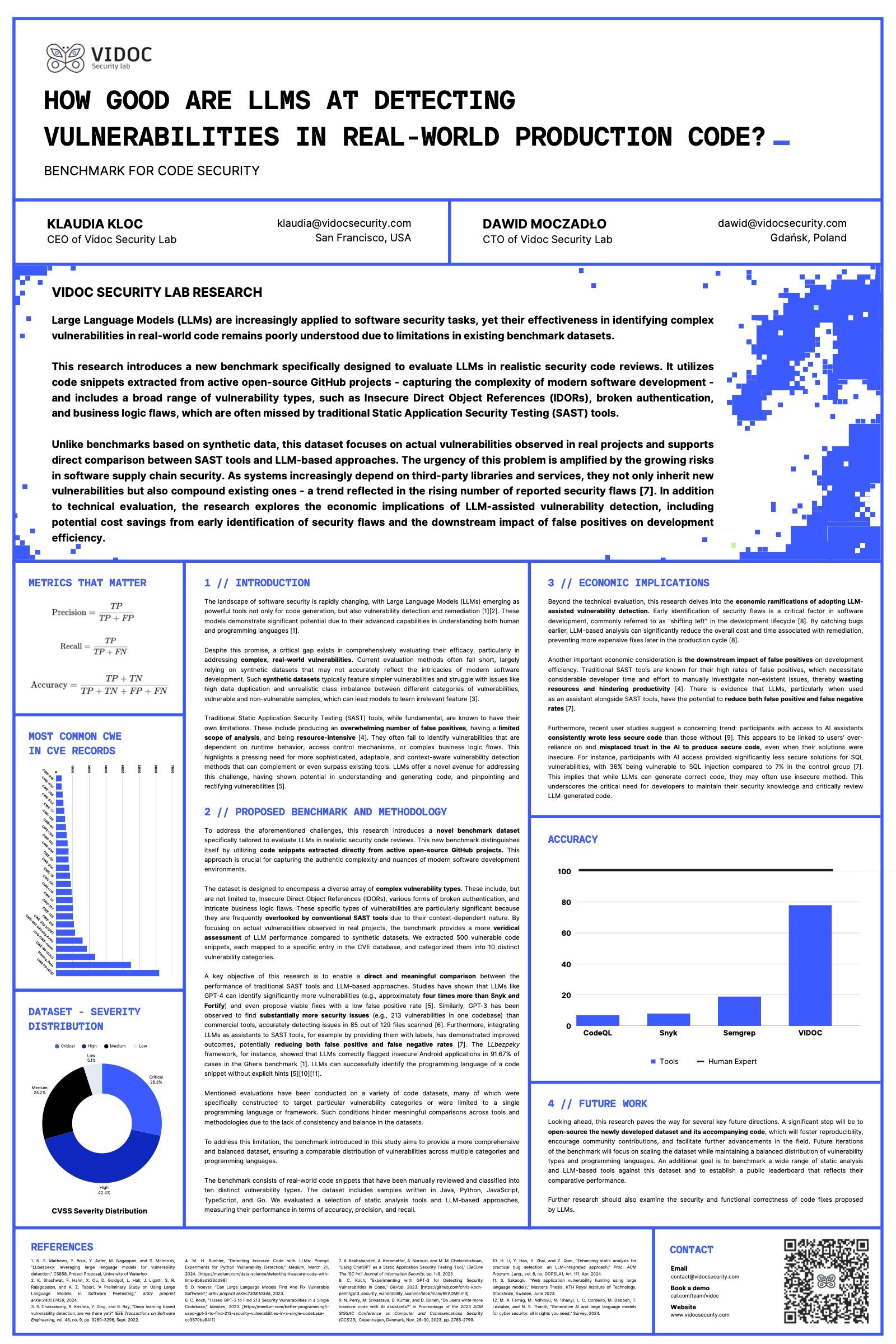 Vidoc Security Lab poster for CAMLIS 2025: How good are LLMs at detecting vulnerabilities in real-world production code?
How good are LLMs at detecting vulnerabilities in production code?
Traditional security tools have limitations when it comes to identifying vulnerabilities that require a deeper understanding of application logic and code context. At the same time, LLMs are becoming increasingly capable of performing tasks that have historically required experienced security researchers.
To better understand these capabilities, we developed a benchmark based on actual vulnerabilities found in open-source software.
Our research covers ten vulnerability categories across five programming languages: Java, Python, JavaScript, TypeScript, and Go. It focuses on vulnerabilities that traditional static analysis tools often struggle to detect, including broken authentication, insecure direct object references (IDORs), and complex business logic flaws.
By comparing traditional SAST tools with LLM-based approaches, we aim to provide a more realistic assessment of AI's capabilities in software security.
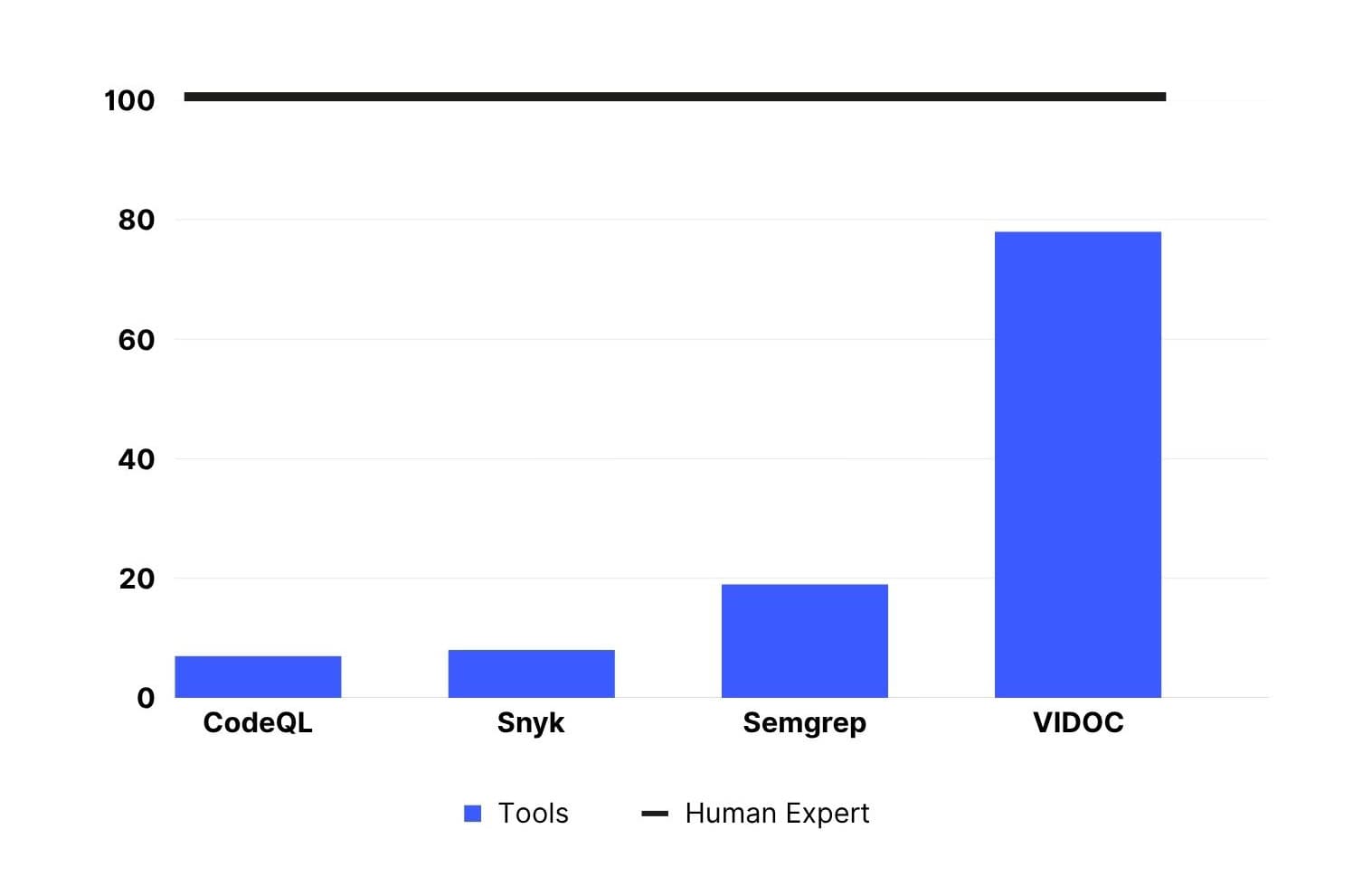 Benchmark accuracy levels - VIDOC vs. traditional SAST tools
The growing threat of AI-powered vulnerability discovery
The ability of LLMs to identify zero-day vulnerabilities has significant implications for the cybersecurity landscape.
Vulnerability research has traditionally required specialized expertise and a considerable investment of time. With LLMs, parts of this process can now be automated and performed at a scale that would be difficult for human researchers to match.
Attackers could use these capabilities to analyze widely used software, identify previously unknown vulnerabilities, and significantly accelerate their discovery process.
This is particularly concerning for software supply chain security. A single vulnerability in a widely adopted open-source dependency can expose thousands of applications and organizations worldwide.
As AI models improve, the cost and effort required to discover vulnerabilities are likely to decrease. Security teams need to prepare for a reality in which attackers can identify security flaws faster than organizations can address them.
Preparing for a new era of software security
At Vidoc Security Lab, we believe that understanding the offensive capabilities of AI is essential to building effective defensive technologies.
Our research aims to better understand how LLMs perform in realistic security scenarios and how these capabilities can be used to identify vulnerabilities before attackers do.
CAMLIS 2025 was an opportunity to share our research with the cybersecurity and machine learning community and contribute to the discussion about the implications of AI-powered vulnerability discovery.
As AI continues to advance, we need to ensure that our ability to defend software evolves just as quickly.
Read our full research: Detecting complex vulnerabilities in real-world code: LLM benchmark for enhanced software security
References
1. N. S. Mathews, Y. Brus, Y. Aafer, M. Nagappan, and S. McIntosh, “LLbezpeky: leveraging large language models for vulnerability detection,” CS858, Project Proposal, University of Waterloo
2. K. Shashwat, F. Hahn, X. Ou, D. Goldgof, L. Hall, J. Ligatti, S. R. Rajagopalan, and A. Z. Tabari, “A Preliminary Study on Using Large Language Models in Software Pentesting,” arXiv preprint arXiv:2401.17459, 2024.
3. S. Chakraborty, R. Krishna, Y. Ding, and B. Ray, “Deep learning based vulnerability detection: are we there yet?” IEEE Transactions on Software Engineering, vol. 48, no. 9, pp. 3280–3296, Sept. 2022.
4. M. H. Buehler, “Detecting Insecure Code with LLMs: Prompt Experiments for Python Vulnerability Detection,” Medium, March 21, 2024. [https://medium.com/data-science/detecting-insecure-code-with-llms-8b8ad923dd98]
5. D. Noever, “Can Large Language Models Find And Fix Vulnerable Software?,” arXiv preprint arXiv:2308.10345, 2023.
6. C. Koch, “I Used GPT-3 to Find 213 Security Vulnerabilities in a Single Codebase,” Medium, 2023. [https://medium.com/better-programming/i-used-gpt-3-to-find-213-security-vulnerabilities-in-a-single-codebase-cc3870ba9411]
7. A. Bakhshandeh, A. Keramatfar, A. Norouzi, and M. M. Chekidehkhoun, “Using ChatGPT as a Static Application Security Testing Tool,” ISeCure The ISC Int'l Journal of Information Security, pp. 1–8, 2023
8. C. Koch, “Experimenting with GPT-3 for Detecting Security Vulnerabilities in Code,” GitHub, 2023. [https://github.com/chris-koch-penn/gpt3_security_vulnerability_scanner/blob/main/README.md]
9. N. Perry, M. Srivastava, D. Kumar, and D. Boneh, “Do users write more insecure code with AI assistants?” in Proceedings of the 2023 ACM SIGSAC Conference on Computer and Communications Security (CCS’23), Copenhagen, Denmark, Nov. 26–30, 2023, pp. 2785–2799.
10. H. Li, Y. Hao, Y. Zhai, and Z. Qian, “Enhancing static analysis for practical bug detection: an LLM-integrated approach,” Proc. ACM Program. Lang., vol. 8, no. OOPSLA1, Art. 111, Apr. 2024.
11. S. Sakaoglu, “Web application vulnerability hunting using large language models,” Master’s Thesis, KTH Royal Institute of Technology, Stockholm, Sweden, June 2023.
12. M. A. Ferrag, M. Ndhlovu, N. Tihanyi, L. C. Cordeiro, M. Debbah, T. Lestable, and N. S. Thandi, “Generative AI and large language models for cyber security: all insights you need,” Survey, 2024.