
The Fable 5 shutdown is not just an Anthropic story. It is a warning that access to AI cyberdefense can disappear overnight.
On June 9, Anthropic launched Claude Fable 5. On June 12, a US export-control directive forced Anthropic to suspend access to Fable 5 and Mythos 5. The directive targeted foreign nationals, including Anthropic's own non-US employees. In practice, both models went dark for all customers.
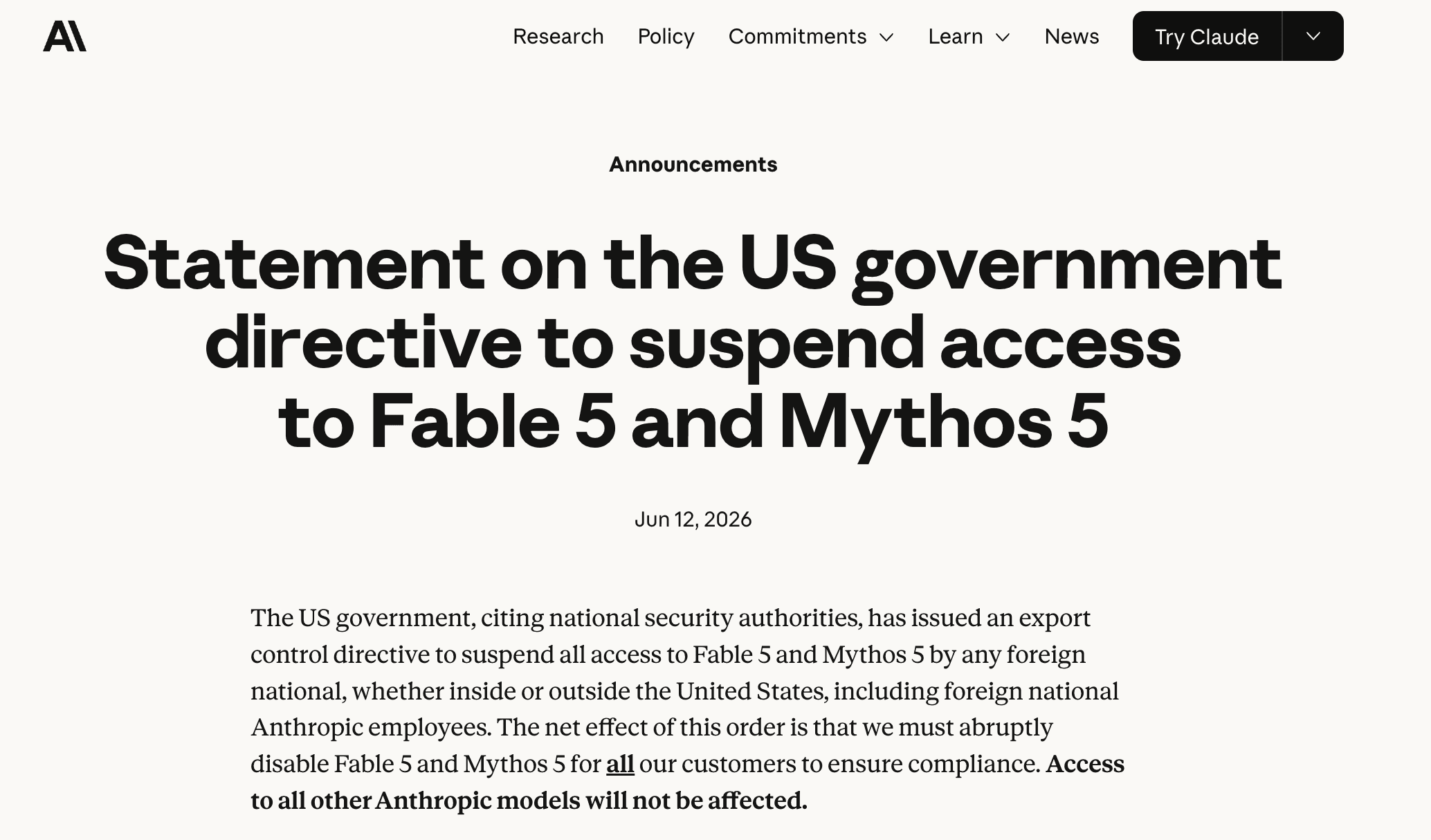 Anthropic's June 12 statement announcing the US government directive to suspend access to Fable 5 and Mythos 5.
Anthropic's June 12 statement said the directive applied to foreign nationals, including Anthropic's own foreign-national employees, and forced the company to disable Fable 5 and Mythos 5 for all customers.1
Anthropic's June 12 statement announcing the US government directive to suspend access to Fable 5 and Mythos 5.
Anthropic's June 12 statement said the directive applied to foreign nationals, including Anthropic's own foreign-national employees, and forced the company to disable Fable 5 and Mythos 5 for all customers.1
That is the part security leaders should care about: a model built to help defenders find vulnerabilities became unavailable almost immediately, for reasons outside the customer's control.
What happened
- April 2026 — Anthropic gave selected partners access to Mythos through Project Glasswing.2 It described Mythos as a powerful cyber model for finding serious vulnerabilities in real software.
- Jun 9, 2026 — Anthropic launched Claude Fable 5, described as a Mythos-class model made safe for general use. It also launched Claude Mythos 5 for a small group of cyberdefenders and infrastructure providers.
- Jun 12, 2026 — Anthropic suspended access to both Claude Fable 5 and Claude Mythos 5. Anthropic said a US export-control directive required suspending access for foreign nationals, and the practical effect was disabling both models for all customers.
Three days from launch to shutdown.
The jailbreak was not the whole story
The first explanation was technical: Amazon reportedly raised concerns that Fable could be jailbroken. David Sacks framed the issue as Anthropic releasing a dangerous model with safety rules that could fail. From that view, Anthropic needed to patch the bypass or take the model down.3
Anthropic's implied counterargument is also understandable: a narrow, effortful jailbreak is not the same thing as handing someone a working cyberweapon.4
Both things can be true. A jailbreak can be serious without being magic. A model can be dangerous without turning every answer into an exploit.
The Axios follow-up makes the story messier.5 The dispute also involved trust, political optics, compliance, and whether Anthropic knew how to talk to this administration.
That matters because it proves the larger point. Access to a powerful model is not controlled only by benchmarks or safety claims. It can depend on the relationship between a vendor and a government.
The real issue is access
Fable was Mythos-class capability with stricter safety rules.
Safety rules can stop a model from answering. They do not make the model less capable underneath. If someone bypasses the rules, the model did not learn a new skill. The restriction failed.
That is why the shutdown did not remove this kind of vulnerability discovery from the world. It removed access to Anthropic's version of it.
We tested this directly. Using public APIs, public models, and an open-source agent, we reproduced important parts of Anthropic's published Mythos findings.6 Public models found the same kind of old OpenBSD bug and the same kind of certificate-trust bug in Botan.
That does not mean public models match Mythos end to end. Finding a bug is not the same as building a reliable exploit chain. But it does mean the core discovery work is no longer confined to Anthropic's internal systems.
The asymmetry
This creates an uncomfortable asymmetry.
For US-built models like Fable and Mythos, the US government can decide who gets access. China is not slowed by a US export-control directive, and Chinese labs will likely produce comparable capability. There is no guarantee those models will be public or available to European defenders.
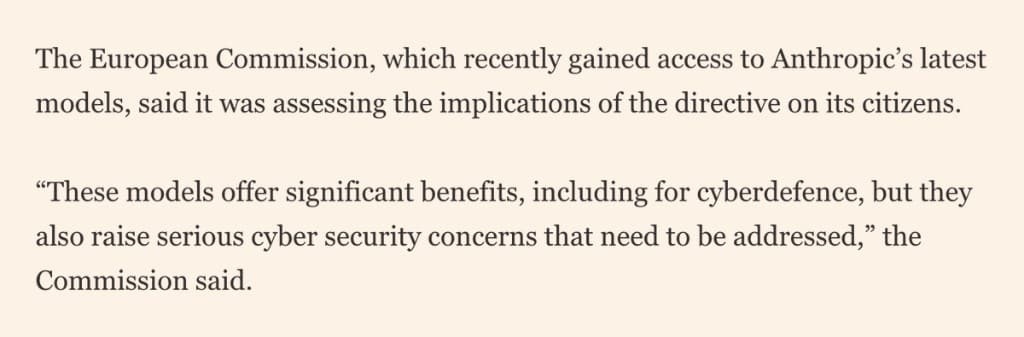 The European Commission said it was assessing the implications of the directive on its citizens, noting these models offer significant benefits for cyberdefence but also raise serious cyber security concerns.
The European Commission had only just gained access to Anthropic's latest models. All it could do was assess the implications.
The European Commission said it was assessing the implications of the directive on its citizens, noting these models offer significant benefits for cyberdefence but also raise serious cyber security concerns.
The European Commission had only just gained access to Anthropic's latest models. All it could do was assess the implications.
So Europe, and much of the world, may end up depending on whatever public models remain available while the US and China control stronger private capability.
That is a bad position for critical infrastructure, banks, telecoms, cloud providers, and large software companies.
What security teams should do
Security teams already think this way about cloud providers, identity systems, certificate authorities, and CI runners. A tool can fail because of an outage, a legal order, a vendor decision, or a policy fight.
AI security tools now belong in that category.
This does not mean every team needs to build its own model. It means model access should be treated like a tool your team depends on, not like a permanent guarantee.
Do not wait for access to one special model.
Ask these questions now:
- Can your scanning workflow keep running if your preferred model disappears?
- Can you route the same task across more than one provider?
- Do you know where your code is processed, and whose laws govern that environment?
- Do you own the validation and prioritization layer, or does that logic live inside a vendor black box?
- For workflows you cannot afford to lose, do you have a public-model or self-hosted fallback?
What matters is not access to one model. It is the workflow around the model: routing, validation, prioritization, evidence, and delivery into remediation.
The Fable shutdown did not make attackers less capable. It made some defenders less equipped.
That is the lesson of the fable: the model was banished, but the threat was not.
Footnotes
-
Anthropic, Statement on the US government directive to suspend access to Fable 5 and Mythos 5. ↩
-
Anthropic, Project Glasswing: Securing critical software for the AI era. ↩
-
David Sacks, public statement on the Anthropic export control, posted to X (@DavidSacks). ↩
-
Pliny the Liberator, reported Fable guardrail bypass. ↩
-
Axios, "They screwed us": Personality clashes sent Anthropic's models offline, and Anthropic flies staff to D.C. to clean up White House fight. ↩
-
Vidoc Security Lab, We Reproduced Anthropic's Mythos Findings With Public Models. ↩